
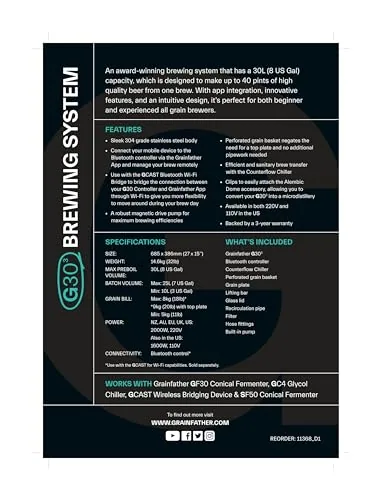
- US model: 1600 W, 120V, 60 Hz, per Grainfather. That is about 13.3 A, so use a GFCI-protected circuit with nothing else big on it.
- Batch size 3–7 US gal (10–25 L) per Grainfather's US page; an older brochure says 6 gal max. Plan on about 5–6 gal of finished beer.
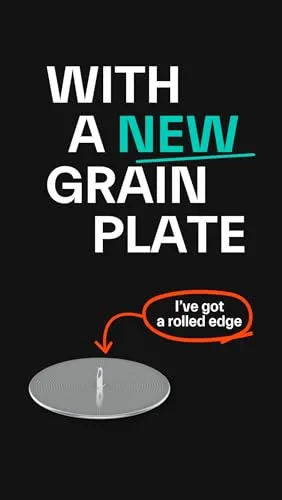
- Grain bill 3.3–18 lb (1.5–8 kg), or about 20 lb (9 kg) with the optional top plate.
- Bluetooth app control comes standard; Wi-Fi needs Grainfather's separate GCAST bridge.
- The counterflow chiller is in some bundles and not others. Check the listing before you buy.
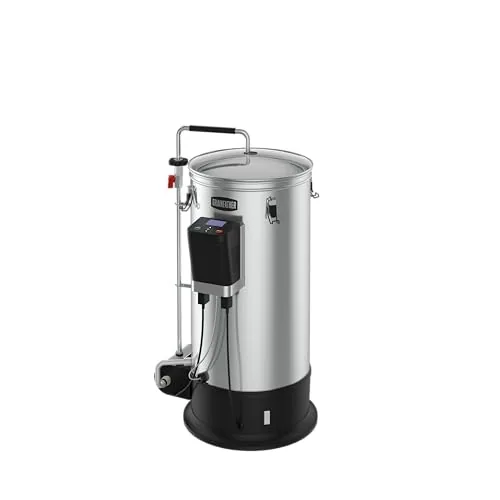
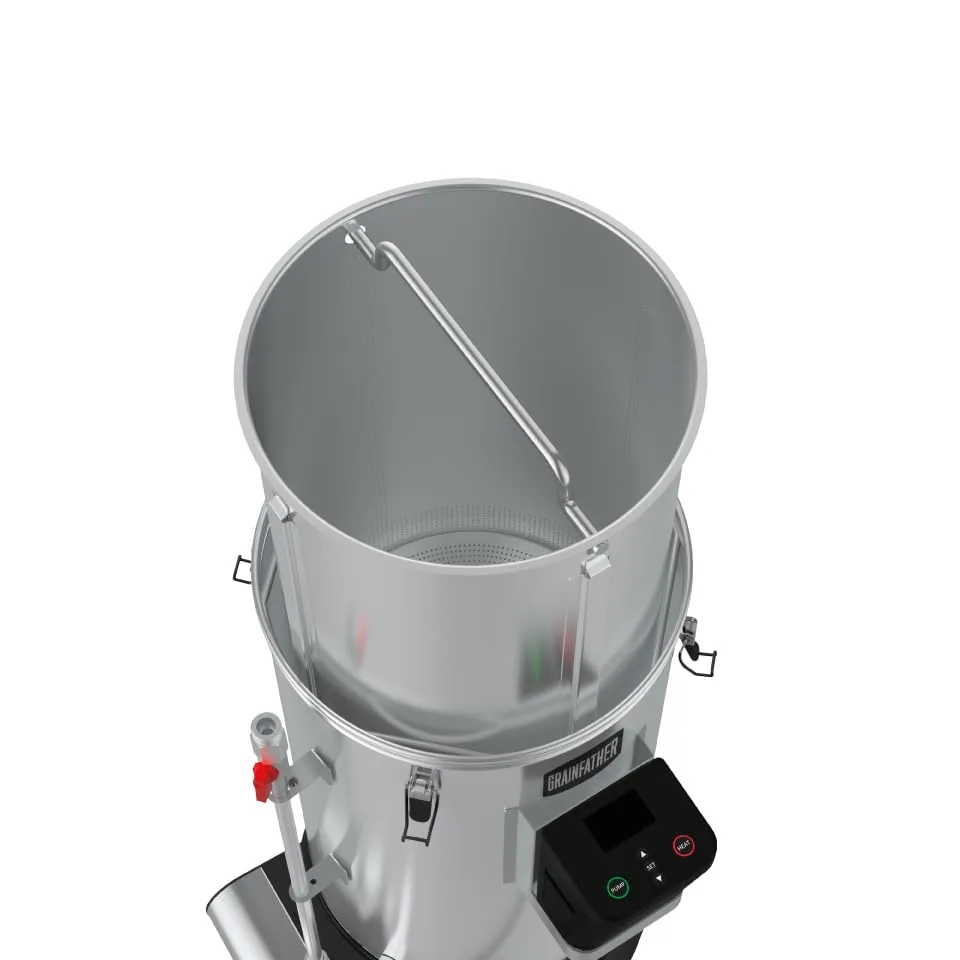
This Grainfather G30 review covers the third-generation G30 (G30v3, written G30³ on the listing) in its US 110V version. Like other electric all-in-ones, it mashes in a lift-out grain basket, then boils in the same stainless vessel. A pump recirculates wort through the grain during the mash and pushes it through a chiller at the end.
We read Grainfather's US product and help pages, the listing and published brewing sources. We did not brew with or install a G30. Where Grainfather's own pages disagree, we name both figures. For more systems, see the brewing systems hub, the going all-grain page and the small-space brewing page.
Who it’s for, and who should skip it
- Brew 5-gallon all-grain batches indoors on a standard 120V GFCI outlet
- Like step-by-step app guidance and remote monitoring on brew day
- Want a built-in pump and a compact footprint (27 × 15 in.)
- Prefer a 304 stainless system from a brand with its own spare parts
- Want to move to 240V later for faster heating and boils
- Often brew high-gravity beers with grain bills over about 18–20 lb
- Want Wi-Fi without buying an extra bridge
- Need a chiller in the box but are looking at a listing that doesn't include one
Pros and cons
- US 110V model rated at 1600 W, the most you can reasonably pull from a 120V circuit
- Built-in pump for recirculation and transfers
- Bluetooth controller with guided brewing in the Grainfather app
- 304 stainless body with an 8-gallon pre-boil capacity
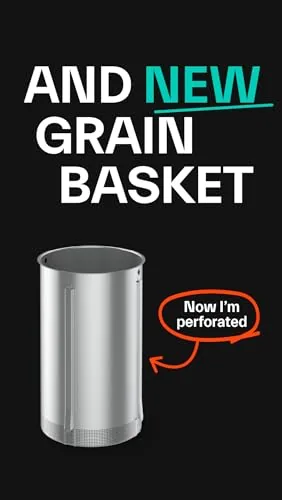
- Redesigned grain basket aimed at better wort flow and fewer stuck mashes, per the listing
- Auto-reset switch, per the listing
- No 240V option on the US model, so heating speed is capped
- Grain bill limited to about 18 lb, or 20 lb with the top plate
- Wi-Fi needs the separate GCAST bridge
- Chiller included only in some bundles
- Grainfather's own pages give different maximum batch sizes (6 vs 7 gal)
Specs
| Volume | 8 US gal |
|---|---|
| Power | 110V (US model) |
| Material | 304 stainless steel |
As stated by the maker or seller; confirm on the listing before you buy.
Is the Grainfather G30 good on a 120V outlet?
Yes, within limits. Grainfather lists the US G30v3 at 1600 W, 120V, 60 Hz. Divide watts by volts and you get about 13.3 A. A standard 15 A household circuit can carry that, but with little room to spare. A garage freezer or space heater on the same circuit can trip the breaker in the middle of the boil.
The safe setup is a dedicated 20 A circuit with GFCI protection, plugged in directly with no extension cord. If the outlet you plan to use isn't GFCI-protected, have an electrician fix that before your first brew. Water, hot wort and household current are a bad mix.
Other Grainfather regions get a 2000 W, 220V version. If you see 2000 W on a spec sheet, it isn't the US unit.
Batch size, grain bill and what's in the box
Grainfather G30v3 110V: maker figures
| Item | Figure | Note |
|---|---|---|
| Power | 1600 W, 120V, 60 Hz | US model |
| Pre-boil volume | 30 L (8 US gal) max | Grainfather US page |
| Batch volume | 10–25 L (3–7 US gal) | Older brochure: 23 L (6 gal) max |
| Grain bill | 1.5–8 kg (3.3–18 lb) | 9 kg (20 lb) with the optional top plate |
| Pump | 6 W | Built in |
| Control | Bluetooth controller, Grainfather app | Wi-Fi via GCAST bridge |
| Size and weight | 685 × 386 mm (27 × 15 in.), 14.6 kg (32 lb) | Unit only |
| Body | 304 stainless steel | Listing |
| Chiller | Counterflow, in some bundles | Check your listing |
| Warranty | 3 years | Per Grainfather |
Source: Grainfather US: G30v3 110V product pages
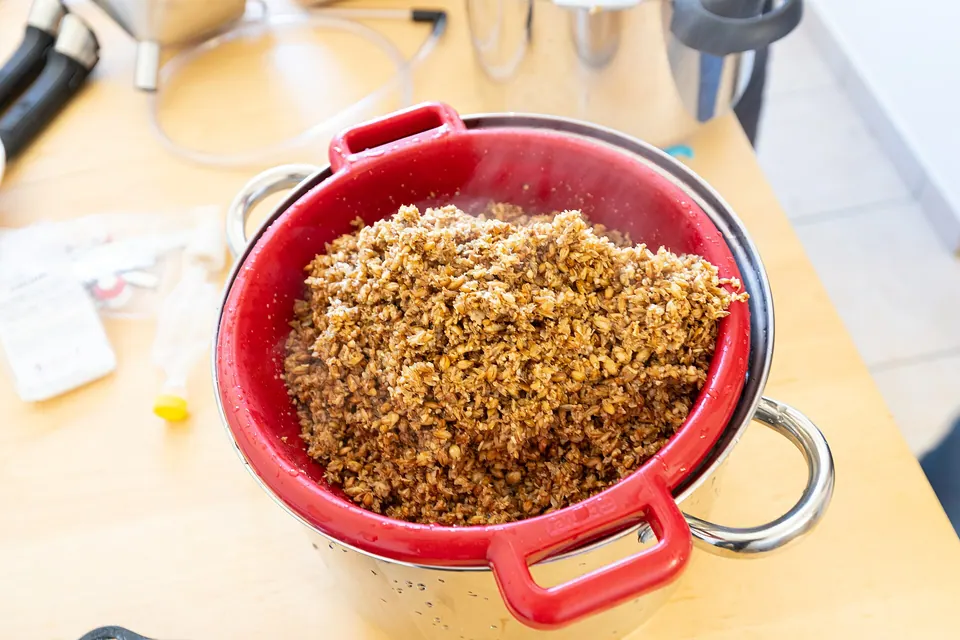
For a standard 5-gallon (19 L) batch of a 5–6% ABV beer, a 10–12 lb grain bill fits easily. An imperial stout at full volume will push past the 18 lb basket. Brew a smaller batch, add malt extract to the boil or use the top plate to reach about 20 lb.
The listing mentions a counterflow wort chiller, but Grainfather sells the G30v3 both with and without it. A counterflow chiller is fast, but it needs a cold water supply and a drain, and you have to clean and sanitize it after each brew.
The app and controller
The G30v3 ships with a Bluetooth controller. In the Grainfather app you load a recipe, and the controller walks through heat-up, mash steps, mash-out and boil, with prompts for hop additions. Remote monitoring over the internet needs the separate GCAST bridge to put it on Wi-Fi.
If you'd rather run it like a simple kettle, you can set temperatures by hand. Either way, keep a record of each batch: the brew-day log prints a sheet for volumes, gravities and temperatures, and the strike water calculator has an all-in-one mode for mash water.
Printable brew-day log and recipe sheetLog mash temperature, pre-boil volume and gravity readings for each G30 batch.What about the Grainfather G40?
Grainfather's bigger G40 isn't in our catalog and gets no review here, but it explains what the G30 is not. Grainfather lists the US G40 at 3300 W on a 220–240V supply, with batches from 10 to 40 L (about 2.6–10.5 gal) after the boil and a grain bill up to about 12 kg (26 lb). That means a 240V circuit, which is a job for a licensed electrician. It won't plug into a normal 120V outlet.
If you don't have 240V and don't plan to add it, the G30 is the right Grainfather. If you might go 240V later but want to keep 5-gallon batches, the Anvil Foundry switches between both voltages.
Grainfather G30 vs Anvil Foundry and BrewZilla
On 120V, the G30v3 and the Anvil Foundry 10.5 are both rated at 1600 W. The Foundry can switch to 2800 W on 240V; the G30 can't. The G30 has a built-in pump and app control as standard; the Foundry's pump comes in a bundle and it has no app. The KegLand BrewZilla Gen 4 35L adds automatic step mashing and RAPT Wi-Fi; its 110V elements total about 1500 W per US retailer listings. Our Grainfather vs Anvil Foundry comparison has the full table.
Whichever system you choose, you still need a fermenter, a hydrometer, a scale and a way to control fermentation temperature. The equipment checklist covers them, and how to brew all-grain walks through an all-in-one brew day.
Alternatives worth a look
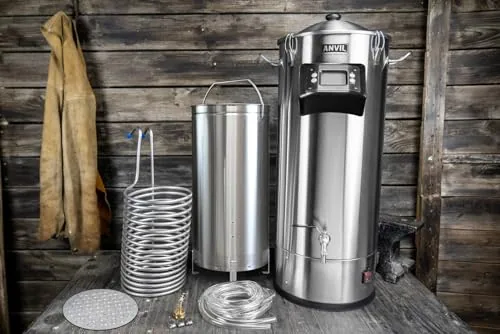
Anvil Foundry 10.5 Gal All-in-One Electric Brewing System
- Volume
- 10.5 gal
- Power
- 240V or 120V via adapter cable
- Material
- Double-wall insulated, ultra-low watt density heaters
Best for Updated Foundry without pump bundle
For a path to 240V: The current Foundry 10.5 runs on 240V or on 120V with an adapter cable, with a delayed-start timer and double-wall insulation.
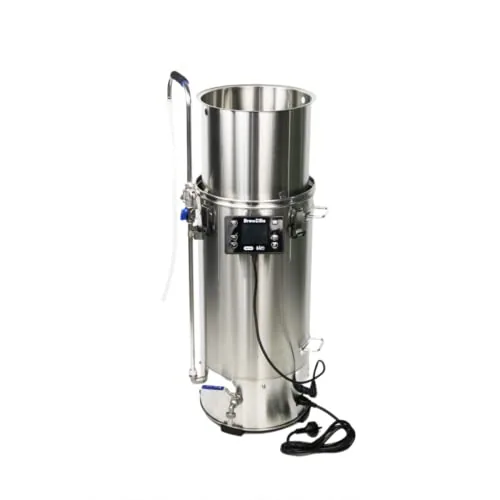
KegLand BrewZilla Gen 4 35L 110V, Wi-Fi/RAPT, with Pump
- Volume
- 35 L (9.24 gal)
- Power
- 110V
- Material
- Stainless steel
Best for 120V all-grain with app control
For Wi-Fi and step mashing: RAPT Wi-Fi, automatic step mashing, a built-in pump and a stainless immersion chiller on 110V.
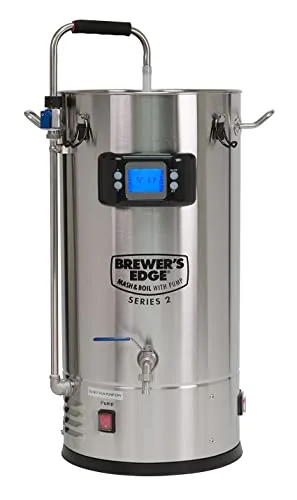
Brewer’s Edge Mash and Boil Series 2 with Pump, 110V
- Volume
- 30 qt
- Power
- 110V
- Material
- Stainless steel
Best for Simple 120V all-grain
For a simpler 110V kettle: A 30 qt all-in-one with an integral pump and a low-density element, without an app.
We read the maker’s specs, the manual and the current listing, and checked them against published brewing sources (Palmer, BJCP, AHA, BYO) and safety guidance where it applies. We did not brew with, install or lab-test this product. We never show scores, star ratings or prices.