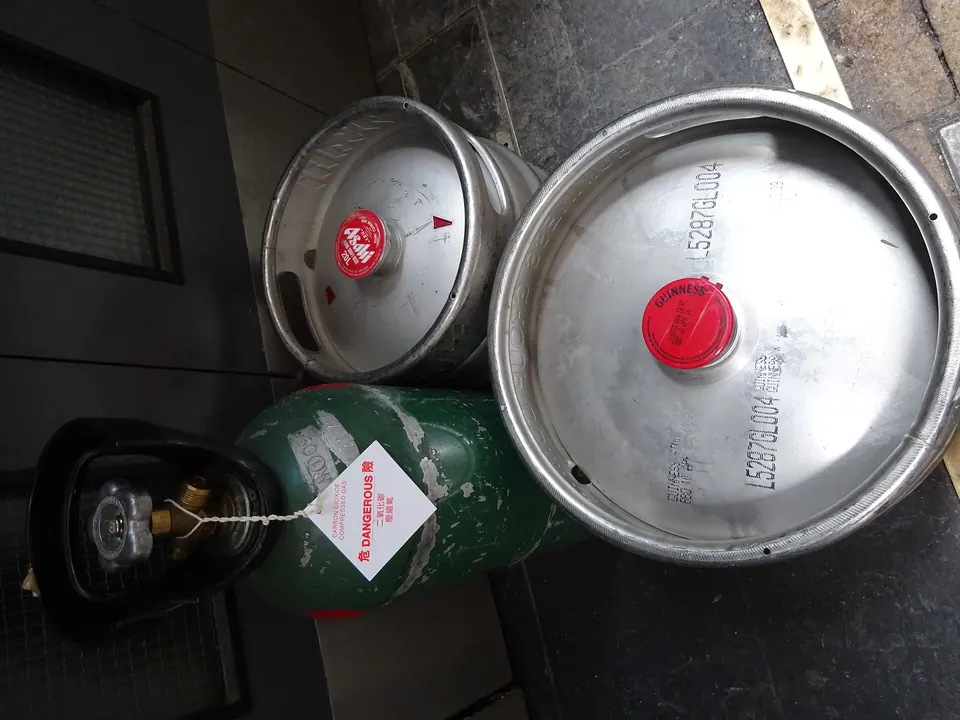
- A homebrew keg system is a corny keg, a CO2 cylinder, a regulator, gas and beer lines with ball lock disconnects, and a way to keep the keg cold.
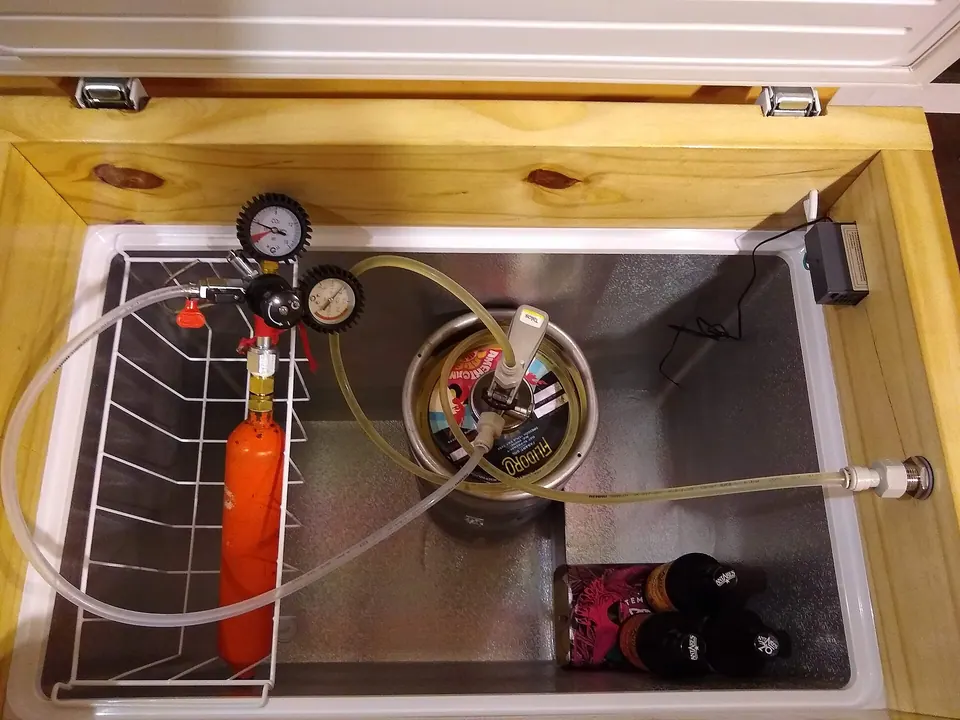
- Northern Brewer’s Draft Brewer kit and Kegco’s conversion kit cover most of it in one box; check which one includes the CO2 tank (Kegco’s does, empty).
- New corny kegs here list 130 PSI operating or maximum pressure; serving pressure sits far below that, around 10–12 psi at fridge temperature for typical ales.
- Keep the cylinder upright and secured, always run it through a regulator, and consider a CO2 monitor in a small room.
The best homebrew keg system replaces bottling day with filling one keg. You rack beer into a 5-gallon ball lock keg, attach CO2 at the right pressure for your fridge temperature and pour once it is carbonated. It costs more up front than bottles, but most brewers who switch never go back for everyday beer.
This list includes ten parts and kits from nine brands so you can build a full system: two starter kits, four sizes of corny keg, a regulator with lines, a CO2 cylinder and a CO2 monitor. You also need cold space, either a kegerator or a fridge; see our kegerator picks. All pressures and sizes are as listed.
Our picks
Draft Brewer Single Homebrew Kegging System with New Ball Lock Keg
Northern Brewer
- Kegs
- 1 new 5 gal ball lock
- Couplers
- Assembled gas and beer lines
- Gauges
- CO2PO dual gauge regulator
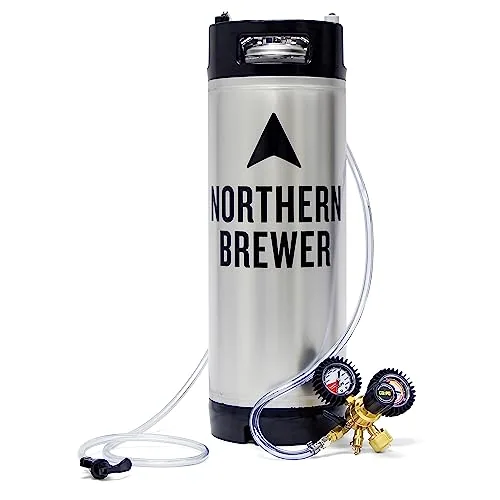
Northern Brewer’s Draft Brewer Single kit includes one new 5-gallon ball lock keg, a CO2PO dual-gauge regulator and fully assembled CO2 and beer lines with washers. A CO2 tank is not listed as included, so add one.
Best for: Your first keg in a fridge you already own
Skip if: You want a faucet through a fridge door
- New keg included
- Dual-gauge regulator
- Lines pre-assembled
- CO2 tank not listed
- Faucet or tap type not listed; check the kit contents
Kegco Homebrew Kegerator Conversion Kit, Single Faucet, Ball Lock
Kegco
- Taps
- 1
- Couplers
- Ball lock gas-in and beer-out
- Gauges
- Dual gauge regulator
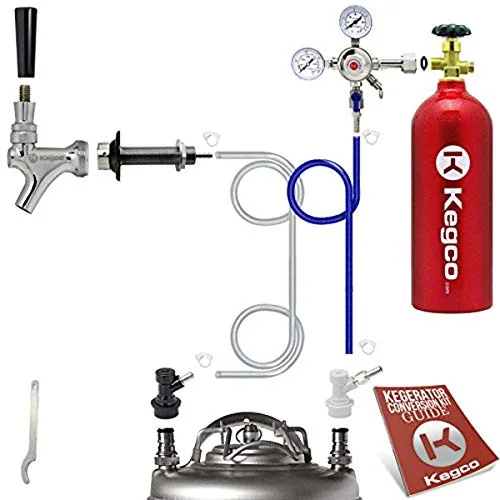
Kegco’s single-faucet homebrew conversion kit includes a dual-gauge regulator that shows PSI and CO2 volume, a ball lock gas-in and beer-out set, an NSF-approved forged brass faucet, beer and air lines and an empty 5 lb aluminum CO2 tank. Add a keg and a fridge.
Best for: Brewers with a spare fridge who want a real faucet
Skip if: You can’t drill the fridge
- CO2 tank included (empty)
- Gauge shows volumes
- Ball lock disconnects
- Keg not included
- Shank length for your fridge door: check before drilling
KegLand New Cornelius Keg, 5 Gal, Ball Lock
KegLand
- Kegs
- 5 gal (19 L), ball lock
- Pressure
- 130 PSI operating
- Material
- 304 stainless
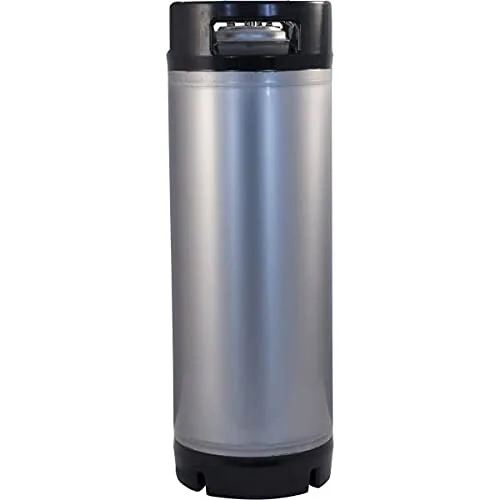
KegLand’s new Cornelius keg holds 5 gal (19 L), is 304 stainless with ball lock posts, lists a 130 PSI operating pressure and has a dry hop tab welded into the lid for hanging a hop bag.
Best for: Adding kegs to an existing setup
Skip if: You need pin lock posts
- 130 PSI operating (listed)
- Dry hop tab
- 304 stainless
- One keg
- Gaskets wear; keep spares
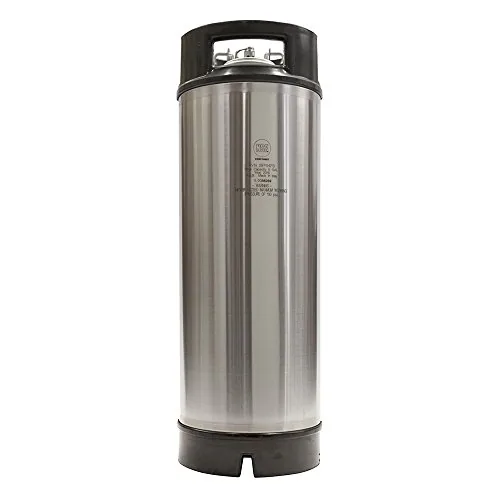
AEB New 5 Gal Ball Lock Keg, Dual Rubber Handle
AEB
- Kegs
- 5 gal ball lock
- Material
- 304 stainless, made in Italy
- Size
- 8.75 × 25 in.
AEB’s 5-gallon ball lock keg is 304 stainless, NSF-approved, made in Italy, with an integrated pull-ring pressure relief in the lid, dual rubber handles and a rubber boot. It measures 8.75 in. across and 25 in. tall.
Best for: Kegs you’ll move around a lot
Skip if: You need to stack kegs
- Pull-ring relief in the lid
- Rubber handles and boot
- Listed dimensions
- Pressure rating not listed on this listing
- Single keg
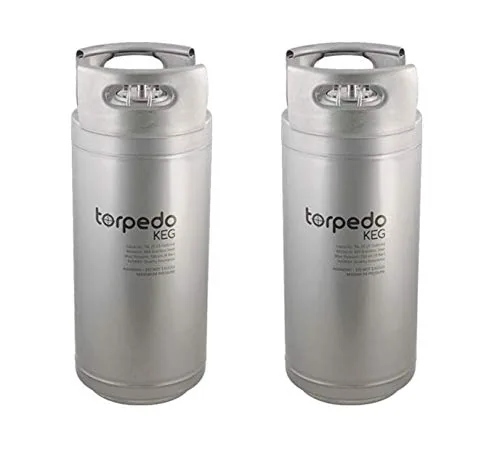
Torpedo Kegs 5 Gal Stackable Ball Lock Kegs, 2-Pack
Torpedo Kegs
- Kegs
- 2 × 5 gal ball lock
- Material
- 304 stainless, laser-welded
- Size
- 130 PSI max
Torpedo’s 2-pack of 5-gallon ball lock kegs is 304 stainless with laser-welded seams, rolled stainless handles and a 130 PSI maximum. They stack, even with disconnects attached, which helps in short kegerators.
Best for: Two kegs in a short space
Skip if: You want rubber boots for dropping on concrete
- Stackable with disconnects on
- 130 PSI max
- Two kegs
- No rubber boot listed
- Gasket kit not listed
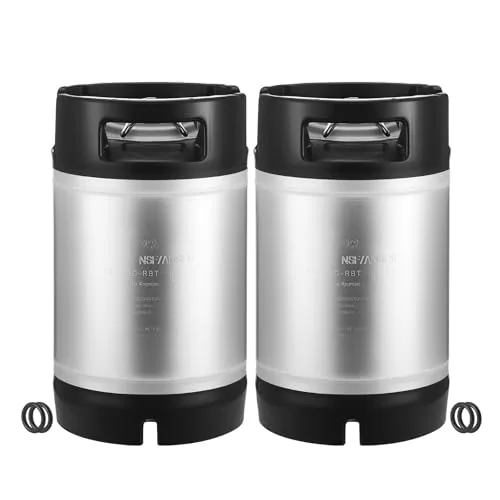
VEVOR 2.5 Gal Ball Lock Kegs, 2-Pack
VEVOR
- Kegs
- 2 × 2.5 gal (9.5 L) ball lock
- Type
- Corny keg
- Material
- 304 stainless
VEVOR’s 2.5 gal (9.5 L) ball lock kegs come as a pair in 304 stainless, rated up to 130 PSI, with a pull-ring valve, dual rubber handles and heavy rubber bottoms. Two half kegs fit where one full keg won’t.
Best for: Split batches and small fridges
Skip if: You brew full 5-gallon batches and want one keg each
- 2.5 gal size
- 130 PSI rating
- Two kegs
- Twice the gaskets to maintain
- Fewer pours per keg
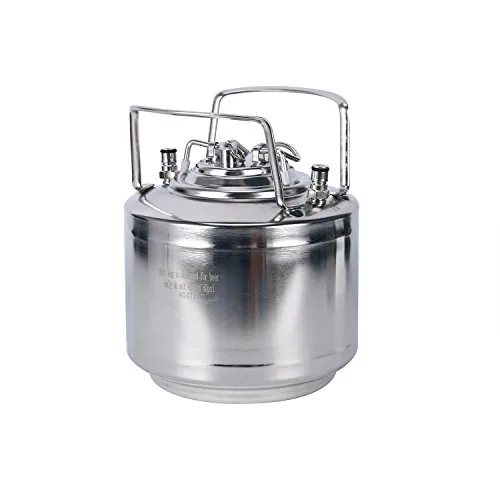
YaeBrew 1.6 Gal Mini Ball Lock Keg System, 6L
YaeBrew
- Kegs
- 1.6 gal (6 L) ball lock
- Gauges
- No CO2 tank
- Material
- Stainless steel
YaeBrew’s 1.6 gal (6 L) stainless mini keg has ball lock posts and a strap handle and stacks with disconnects attached. It fits in a kitchen fridge. A CO2 tank is not included.
Best for: 1–1.5 gallon batches in an apartment
Skip if: You brew 5 gallons
- Fits a home fridge
- Ball lock posts
- Stackable
- CO2 tank not included
- Pressure rating not listed
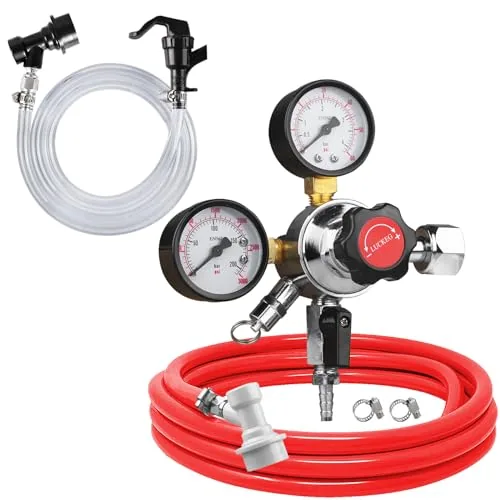
LUCKEG Dual Gauge Regulator with Ball Lock Line Kit
LUCKEG
- Couplers
- Ball lock gas and liquid MFL disconnects
- Gauges
- 0–60 PSI and 0–3000 PSI
- Pressure
- Manual release at 45 PSI
LUCKEG’s kit pairs a CGA320 dual-gauge regulator (0–60 PSI working, 0–3000 PSI tank) with 5 ft gas and beer lines, clamps, swivel nuts and plastic ball lock gas and liquid disconnects. Its manual pressure release opens at 45 PSI.
Best for: Building a system around kegs you already bought
Skip if: You want stainless disconnects
- Lines and disconnects included
- 45 PSI release
- CGA320 inlet for CO2
- Plastic disconnects
- No faucet
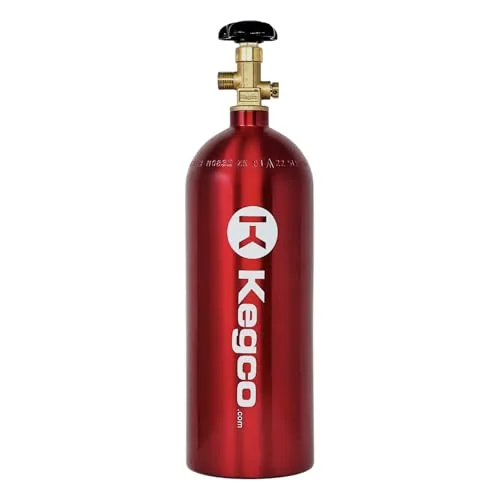
Kegco 3PB5-RED 5 lb Aluminum CO2 Tank
Kegco
- Gauges
- CGA 320 valve
- Size
- 5 lb
- Material
- 6061-T6 aluminum, 1800 PSI service
Kegco’s 3PB5 is a 5 lb 6061-T6 aluminum CO2 tank with a CGA 320 valve, DOT and Transport Canada markings, 1800 PSI service pressure and 3000 PSI test pressure. A 5 lb tank fits inside most kegerators.
Best for: The gas side of any kit without a tank
Skip if: Your kit already includes a cylinder
- CGA 320 valve
- DOT marked
- Aluminum, won’t rust
- Fill status not stated on this listing
- Needs a fill or exchange shop

Aranet4 Wireless CO2 Monitor
Aranet
- Range
- CO2, temperature, humidity, pressure
- Accuracy
- NDIR sensor
- Battery
- Up to 4 years (maker)
The Aranet4 is a battery-powered NDIR CO2 monitor with an e-ink display and an optional buzzer; it also logs temperature, humidity and pressure. Battery life is up to 4 years per the maker. Place it near a kegerator in a closet, basement or small garage.
Best for: Kegerators and keezers in small rooms
Skip if: Your setup is in a large, ventilated space
- NDIR sensor
- Buzzer alert
- Long battery life (maker)
- Sold as an air-quality monitor, not a dedicated CO2 safety alarm: check its alert settings
- App history covers 90 days (maker)
What does a homebrew keg system include?
Think of a keg system in three parts: the keg that holds the beer, the gas side (cylinder, regulator, gas line and gas disconnect) that pushes and carbonates it, and the beer side (beer disconnect, line and faucet) that pours it. Kits bundle different parts, so the table shows what each one leaves you to buy. Every keg here uses ball lock posts, the common standard for new homebrew kegs.
What each kit covers
| Part | Draft Brewer kit | Kegco conversion kit | LUCKEG kit | You add |
|---|---|---|---|---|
| Corny keg | ✓ 1 new 5 gal | ✗ | ✗ | KegLand, AEB, Torpedo, VEVOR or YaeBrew |
| Regulator | ✓ Dual gauge | ✓ Dual gauge | ✓ Dual gauge | — |
| CO2 cylinder | ✗ Not listed | ~ 5 lb, empty | ✗ | Kegco 3PB5 + a fill |
| Gas and beer lines | ✓ Assembled | ✓ | ✓ 5 ft each | — |
| Disconnects | ✓ (assembled lines) | ✓ Ball lock | ✓ Ball lock (plastic) | — |
| Faucet | Not listed | ✓ Forged brass | ✗ | A faucet or picnic tap |
| Cold space | ✗ | ✗ (your fridge) | ✗ | Kegerator or fridge |
Source: Maker listings, November 2026
12 oz pours per full keg
Arithmetic: 128 fl oz per gallon ÷ 12, before losses to sediment and foam
How to set up a homebrew keg system and force carbonate
- Clean and leak-test the keg
Clean the keg, replace worn O-rings, sanitize, then pressurize it a little and check every seal with soapy water.
- Fill the CO2 cylinder
Get the cylinder filled or swapped, check the stamped test date, and secure it upright.
- Attach the regulator
Thread a CO2 regulator (CGA320 inlet) onto the cylinder with its washer, close the output, then open the cylinder valve slowly.
- Rack and purge
Transfer cold beer into the keg, seal the lid and purge headspace oxygen by pressurizing and venting a few times with the pull ring.
- Set serving pressure from the chart
Read the pressure for your fridge temperature and target volumes below, then wait one to two weeks for the beer to reach it. The keg carbonation chart also adds altitude.
- Pour and maintain
Pour, then clean lines regularly with a line cleaner per its label. For bottling a few beers from the keg, see our beer gun picks.
Keg pressure (psi, sea level) by beer temperature and target CO2 volumes
| Beer temp | 1.8 vol | 2.0 vol | 2.2 vol | 2.4 vol | 2.6 vol | 2.8 vol | 3.0 vol | 3.2 vol |
|---|---|---|---|---|---|---|---|---|
| 32°F 0°C | 1.6 | 3.5 | 5.4 | 7.3 | 9.2 | 11.0 | 12.9 | 14.8 |
| 34°F 1.1°C | 2.3 | 4.3 | 6.3 | 8.2 | 10.2 | 12.1 | 14.1 | 16.0 |
| 36°F 2.2°C | 3.1 | 5.1 | 7.2 | 9.2 | 11.2 | 13.3 | 15.3 | 17.3 |
| 38°F 3.3°C | 3.9 | 6.0 | 8.1 | 10.2 | 12.3 | 14.4 | 16.5 | 18.6 |
| 40°F 4.4°C | 4.7 | 6.8 | 9.0 | 11.2 | 13.4 | 15.5 | 17.7 | 19.8 |
| 42°F 5.6°C | 5.5 | 7.7 | 10.0 | 12.2 | 14.4 | 16.7 | 18.9 | 21.1 |
| 44°F 6.7°C | 6.3 | 8.6 | 10.9 | 13.2 | 15.5 | 17.8 | 20.1 | 22.4 |
| 46°F 7.8°C | 7.1 | 9.5 | 11.8 | 14.2 | 16.6 | 19.0 | 21.3 | 23.7 |
| 48°F 8.9°C | 7.9 | 10.4 | 12.8 | 15.3 | 17.7 | 20.1 | 22.6 | 25.0 |
| 50°F 10°C | 8.7 | 11.3 | 13.8 | 16.3 | 18.8 | 21.3 | 23.8 | 26.3 |
| 52°F 11.1°C | 9.6 | 12.2 | 14.8 | 17.3 | 19.9 | 22.5 | 25.1 | 27.6 |
| 54°F 12.2°C | 10.4 | 13.1 | 15.7 | 18.4 | 21.1 | 23.7 | 26.3 | 29.0 |
| 56°F 13.3°C | 11.3 | 14.0 | 16.7 | 19.5 | 22.2 | 24.9 | 27.6 | 30.3 |
Formula: PSI = −16.6999 − 0.0101059·T + 0.00116512·T² + 0.173354·T·V + 4.24267·V − 0.0684226·V². Checked against the BYO grid (40°F and 2.4 vol: 11.19 psi by formula, 11.2 psi on the chart). Regulator gauges read relative to local air pressure. BYO notes that Denver needs about 3 psi over the sea-level chart; add roughly 0.5 psi per 1,000 ft. Sources: BYO: Carbonation priming chart; Brewer's Friend: Force carbonation chart; Brewers Association: Draught Beer Quality Manual.
Keg system mistakes to avoid
- Connecting CO2 without a regulator. Cylinder pressure is in the thousands of PSI; always go through a regulator.
- Skipping the leak test. A slow leak empties a tank and can raise CO2 in a closed room.
- Mixing ball lock and pin lock. Match the disconnects to the keg posts.
- Carbonating warm beer at serving pressure. Warm beer takes up less CO2; carbonate cold.
- Using a nitrogen regulator for CO2. CO2 and nitrogen cylinders use different valves and regulators; use one made for CO2.
CO2 displaces oxygen. Put kegerators and keezers in ventilated spaces, keep a CO2 monitor nearby in closets and basements, and leave and ventilate if you suspect a leak.
Source: Kegco: Everything you need to know about CO2Who should pick which keg system?
| If you… | Pick |
|---|---|
| Want the simplest first keg in your fridge | Northern Brewer Draft Brewer kit + Kegco 3PB5 tank |
| Want a faucet through a fridge door | Kegco single-faucet conversion kit + a corny keg |
| Already have a regulator and need kegs | KegLand, AEB or Torpedo kegs |
| Brew small batches or have a small fridge | VEVOR 2.5 gal pair or YaeBrew 1.6 gal |
| Bought kegs first | LUCKEG regulator with lines |
| Keg in a closet or basement | Add the Aranet4 CO2 monitor |
Still deciding between bottles and kegs? Bottling needs priming sugar; work it out with the priming sugar calculator, and price both routes in the budget builder. Gas parts are covered in our CO2 regulator picks; browse kegging and draft and switching to kegs.
The Northern Brewer Draft Brewer kit plus a Kegco 5 lb tank is the best homebrew keg system for a first keg in a fridge you own. Choose the Kegco conversion kit if you want a door faucet, add KegLand, AEB or Torpedo kegs as you grow, and put an Aranet4 next to any kegerator in a small room.
Before you buy, read how to keg homebrew and force carbonate and carbonation explained: volumes of CO2. For a closer look, see Kegco HBK309S-2 homebrew kegerator review and Bottling vs kegging homebrew.
We compared kit contents, keg size and listed pressure, regulator ranges and relief points, cylinder markings and monitor specs from maker listings and manuals, and used BYO’s carbonation grid and published CO2 safety guidance. We did not fill or pour from these kegs. No scores, ratings or prices.