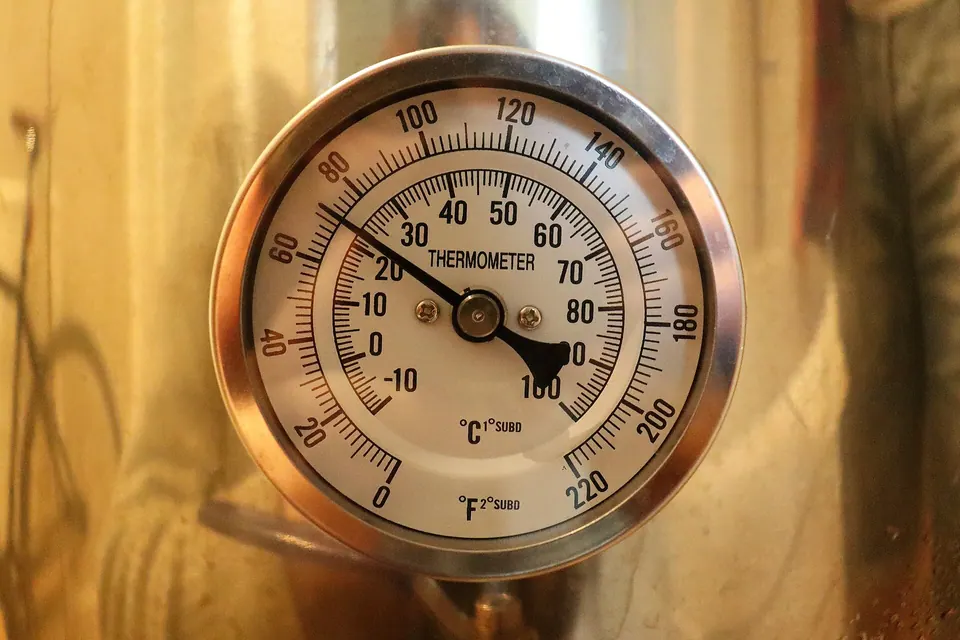
- A fermentation temperature controller switches a fridge (cooling outlet) and a heater (heating outlet) on and off to hold the beer at your set point.
- Plug-in dual-stage controllers in our catalogue come almost entirely from Inkbird, so this list adds the cooling and heating gear the controller runs and a Tilt for logging, from four other brands.
- Check the listed load before you plug in: 1100 W for the ITC-308, 1200 W for the ITC-308S, 1800 W for the ITC-608T, per their listings.
- Tape the probe to the fermenter under insulation, or use a thermowell, so you control the beer, not the air.
The best fermentation temperature controller is a plug-in box with two outlets, one for cooling and one for heating, and a probe that reads the fermenter. You plug a fridge or freezer into the cooling side and a heat wrap or belt into the heating side, set a temperature, and the controller switches whichever one is needed. Yeast makers publish temperature ranges for each strain, and fermentation itself releases heat, so holding the beer inside that range is one of the biggest upgrades a brewer can make.
Honest note: for plug-in dual-stage controllers, our catalogue is essentially an Inkbird lineup. Rather than pad the list with look-alikes, it covers four Inkbird models and then the parts a controller drives, from BrewBuilt, Northern Brewer, Brewer’s Best and Tilt. Every spec is as listed; where listings disagree, we say so.
Our picks
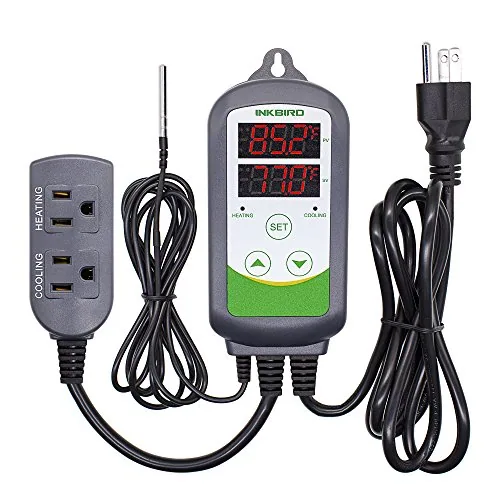
Inkbird ITC-308 Dual-Stage Temperature Controller, 110V
Inkbird
- Outputs
- 2 outlets: heating and cooling
- Range
- °C/°F display, high/low alarms
- Power
- 110V, 10A, 1100 W max (listing)
The Inkbird ITC-308 has separate heating and cooling outlets, shows measured and set temperature at the same time, offers high and low alarms and an adjustable compressor delay to protect a fridge. This listing gives 1100 W maximum at 110V (10 A). Other ITC-308 listings show different load figures, so use the number in the manual that ships with yours.
Best for: A fridge or chest freezer plus a heat wrap
Skip if: You want to check the beer from your phone
- Heat and cool outlets
- Compressor delay
- High/low alarms
- Load rating differs between listings; follow the manual
- No app
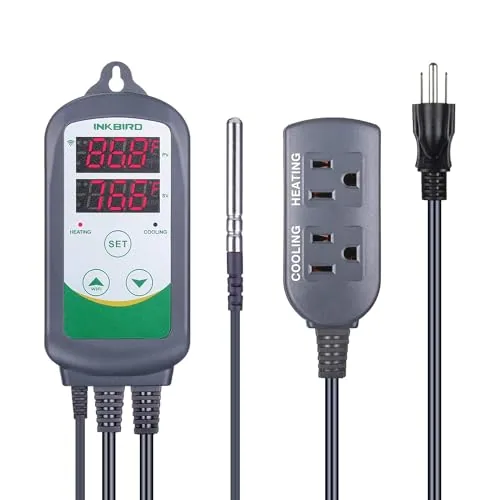
Inkbird ITC-308 Wi-Fi Dual-Stage Temperature Controller, 110V
Inkbird
- Outputs
- 2 outlets: heating and cooling
- Range
- °C/°F, calibration, high/low alarms
- Power
- 110V, 1100 W max (listing)
The ITC-308 Wi-Fi keeps the dual-relay layout and adds the InkbirdSmart app on a 2.4 GHz network, plus temperature calibration and limit alarms. Listed maximum output is 1100 W at 110V.
Best for: Brewers who ferment in a garage or basement they don’t visit daily
Skip if: Your router is 5 GHz only or far from the chamber
- App monitoring and alarms
- Calibration
- Heat and cool outlets
- Needs 2.4 GHz Wi-Fi
- Same 1100 W listed limit as the basic model
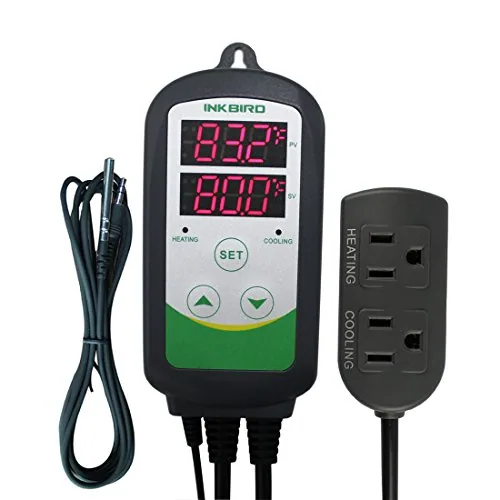
Inkbird ITC-308S Dual-Stage Controller with Stainless Probe
Inkbird
- Material
- 100–240V; IP68 stainless probe
- Outputs
- Dual relay: heating and cooling
- Range
- °C/°F, alarms
The ITC-308S swaps the standard sensor for a stainless IP68 NTC probe you can slide into a thermowell or liquid. The listing says 100–240V and 1200 W maximum at 110V, with over-temperature and sensor-error alarms.
Best for: Stainless conicals or buckets with a thermowell
Skip if: You don’t have a thermowell; the standard probe taped to the side works fine
- Stainless waterproof probe
- 1200 W listed at 110V
- Dual relay
- Probe length not listed
- No app
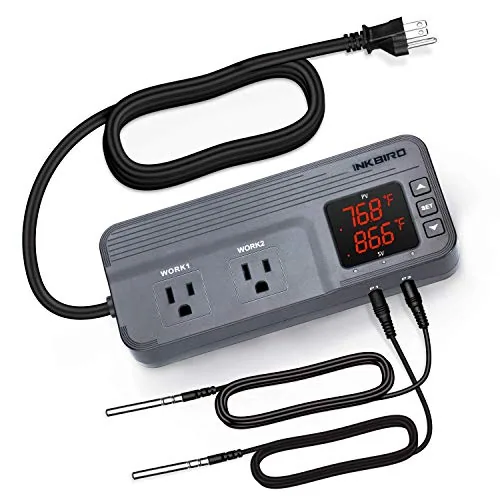
Inkbird ITC-608T Dual-Probe Temperature Controller, 1800W
Inkbird
- Material
- ETL listed, up to 1800 W
- Outputs
- Dual stage outlets
- Range
- °C/°F, 12 time periods
The ITC-608T is ETL listed, rated up to 1800 W, has two waterproof probes with a −40 to 212°F (−40 to 100°C) range, a 12-period time schedule, compressor delay and memory after a power cut. The schedule lets you step a lager up for a diacetyl rest without touching it.
Best for: Lager schedules and ramps
Skip if: You only hold one temperature
- ETL listed
- Two probes
- 12 time periods
- More menus to learn
- Bigger than you need for one ale fridge
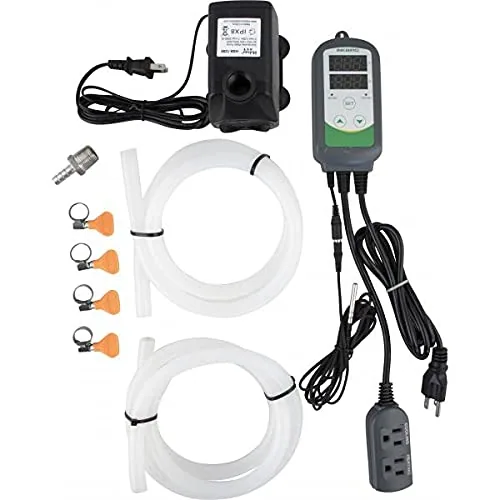
BrewBuilt Chilling Pump Kit, 800 GPH
BrewBuilt
- Material
- 800 GPH submersible pump
- Type
- Recirculation pump kit
BrewBuilt’s Chilling Pump Kit pairs an 800 GPH submersible pump with an Inkbird dual-stage controller, two 5 ft lengths of 3/8 in. tubing, clamps and a barb fitting. Drop the pump in ice water or glycol and the controller runs it to cool a coil or jacketed fermenter.
Best for: Cooling a fermenter with a coil, like the HOOLOO ZX30S
Skip if: Your fermenter has no coil or jacket
- Controller included
- 800 GPH pump
- Tubing and clamps included
- Controller model not named
- Needs a coolant source
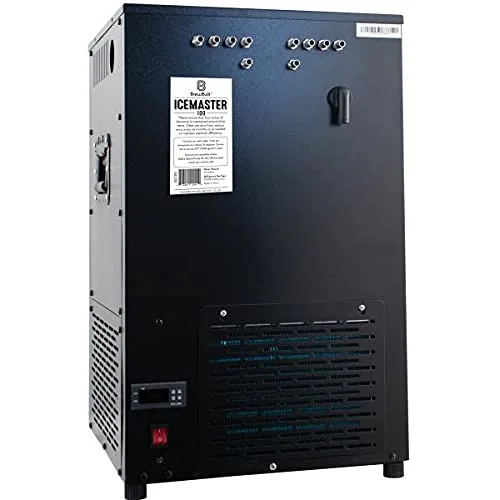
BrewBuilt IceMaster 100 Glycol Chiller
BrewBuilt
- Volume
- 30 L (8 gal) water tank
- Outputs
- 10 stainless bulkheads, 3/8 in. barbs
- Range
- 950 W / 3200 BTU cooling, 110V 3.6 A
The BrewBuilt IceMaster 100 is a 110V glycol chiller listed at 3.6 A, with a 3/8 HP compressor, 950 W (3200 BTU) cooling capacity, a 30 L (8 gal) tank and ten stainless bulkheads with 3/8 in. barbs.
Best for: Two or more coil-cooled fermenters
Skip if: One fermenter in a fridge already works for you
- 950 W / 3200 BTU listed
- 110V, 3.6 A
- Ten bulkheads
- Needs pumps, coils and controllers per vessel
- Glycol mix per the manual
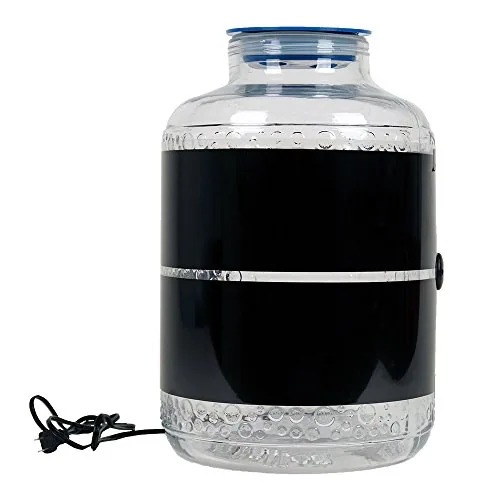
Northern Brewer FermoTemp Electric Fermentation Heater
Northern Brewer
- Material
- Flexible, extra-thick construction
- Outputs
- Wrap heater, 110V 35 W
- Type
- Fermentation heater
Northern Brewer’s FermoTemp is a flexible 35 W, 110V wrap that tapes to glass, plastic or stainless fermenters. The maker tells you to run it through an electronic temperature controller, which is exactly the heating outlet’s job.
Best for: Cold garages and basements in winter
Skip if: Your fermentation space never drops below your yeast’s range
- 35 W gentle heat
- Fits any fermenter material
- Plugs into a standard outlet
- Needs tape to attach
- No built-in thermostat
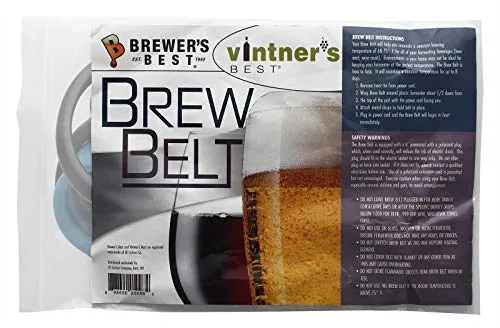
Brewer’s Best Brew Belt Fermentation Heater
Brewer's Best
- Outputs
- Heating belt for 6–6.5 gal (23 L) plastic fermenters
- Range
- Holds 75–80°F (maker)
- Type
- Fermentation heater
Brewer’s Best Brew Belt wraps a 6–6.5 gal (23 L) plastic fermenter and holds it at 75–80°F per the maker. On its own it can overshoot many ale yeasts, so plug it into a controller’s heating outlet.
Best for: Warm-fermenting yeast and wine in a cold room
Skip if: You ferment clean ales in the low 60s °F
- Fits standard buckets
- Simple wrap-around belt
- Maker-stated 75–80°F
- Fixed output without a controller
- Plastic fermenters only per the maker
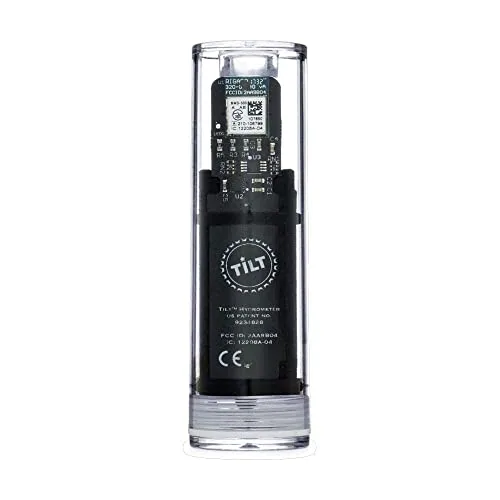
Tilt Wireless Hydrometer & Thermometer (Black)
Tilt
- Range
- SG 0.990–1.120
- Accuracy
- ±0.002 SG (per Tilt)
- Connectivity
- Bluetooth to app or Tilt Pi
- Battery
- 12–24 months (per maker)
The Tilt floats in the beer and reports gravity and temperature over Bluetooth to an app or Tilt Pi, with ±0.002 SG accuracy over 0.990–1.120 and a 12–24 month battery per Tilt. It doesn’t switch anything, but it shows what the beer itself is doing.
Best for: Verifying the probe placement and logging fermentation
Skip if: You don’t want another app
- Logs beer temperature and gravity
- Pre-calibrated
- No sampling needed
- Not a controller
- Bluetooth range through a fridge wall varies
How much load can each fermentation temperature controller handle?
Add up what you plug in. A kegerator-style fridge draws little running current (Kegco lists 1.7 running amps for its HBK309S-2K), and a fermentation wrap draws 35–40 W, so most chambers sit far below these limits. The limit matters if you plug in a space heater or a large freezer, and amps = watts ÷ volts (1100 W ÷ 110V = 10 A).
Listed maximum output load
Watts at 110V as each listing states it
Controllers and the gear they run
| Product | Role | Listed spec | App |
|---|---|---|---|
| Inkbird ITC-308 | Controller | Heat + cool, 1100 W (110V) | ✗ |
| Inkbird ITC-308 Wi-Fi | Controller | Heat + cool, 1100 W (110V) | ✓ 2.4 GHz |
| Inkbird ITC-308S | Controller | IP68 stainless probe, 1200 W (110V) | ✗ |
| Inkbird ITC-608T | Controller | 2 probes, 12 periods, 1800 W, ETL | ✗ |
| BrewBuilt Chilling Pump Kit | Cooling loop | 800 GPH pump + Inkbird controller | ✗ |
| BrewBuilt IceMaster 100 | Cooling source | 950 W / 3200 BTU, 3.6 A | ✗ |
| Northern Brewer FermoTemp | Heater | 35 W, 110V | ✗ |
| Brewer’s Best Brew Belt | Heater | Holds 75–80°F (maker) | ✗ |
| Tilt (black) | Logger | ±0.002 SG, temperature | ✓ Bluetooth |
Source: Maker listings, November 2026
Plug the controller into a GFCI-protected outlet, avoid daisy-chained power strips and extension cords, keep the controller outside the wet chamber where you can, and stay under the load in your manual. Some heater listings carry their own use warnings, so read each manual before you wrap a fermenter.
What temperature should your controller hold?
Start from the yeast maker’s range, not a generic number. Many brewers set the controller a few degrees below the top of the range during active fermentation, because the beer runs warmer than the air while the yeast is working. The table pulls maker figures for four common dry yeasts.
Dry yeast by the maker’s numbers
| Yeast | Use | Fermentation temp | Dose | Attenuation / tolerance | Rehydration |
|---|---|---|---|---|---|
| SafAle US-05 Fermentis | Ale (American) | 18–26°C (64.4–78.8°F) | 50–80 g/hL | 78–82%; not listed on the product page | Optional: ≥10× its weight of sterile water or boiled, hopped wort at 25–29°C (77–84°F), 15–30 min; or direct pitch at or above fermentation temperature |
| SafAle S-04 Fermentis | Ale (English) | 18–26°C (64.4–78.8°F) | 50–80 g/hL | 74–82%; 9–11% ABV | Optional: ≥10× its weight of sterile water or boiled, hopped wort at 25–29°C (77–84°F), 15–30 min; or direct pitch at or above fermentation temperature |
| SafLager W-34/70 Fermentis | Lager | 12–18°C (53.6–64.4°F) | 80–120 g/hL | 80–84%; 9–11% ABV | Optional: ≥10× its weight of sterile water or boiled, hopped wort at 15–25°C (59–77°F), 15–30 min; or direct pitch at or above fermentation temperature |
| LalBrew Nottingham Lallemand | Ale (English) | 10–25°C (50–77°F) | 50–100 g/hL | 78–84%; 14% ABV | Dry pitching is the maker's preferred method (no significant difference vs rehydration, per Lallemand) |
| LalBrew Voss (kveik) Lallemand | Ale (kveik) | 25–40°C (77–104°F) Optimum 35–40°C (95–104°F) per Lallemand | 50–100 g/hL | 76–82%; 12% ABV | Per the sachet |
| Lalvin EC-1118 Lallemand | Wine, cider, mead | 10–30°C (50–86°F) | 25 g/hL | Ferments dry; 18% v/v (subject to conditions) | 35–40°C (95–104°F) water for 20 min with Go-Ferm Protect Evolution (30 g/hL), then temper to within 5–10°C of the must |
Sources: Fermentis: SafAle US-05 product page; Fermentis: SafAle S-04 product page; Fermentis: SafLager W-34/70 product page; Lallemand: LalBrew Nottingham technical data sheet; Lallemand Brewing: LalBrew Voss Kveik Ale Yeast product page; Lallemand: Lalvin EC-1118 technical data sheet. 1 hL = 26.4 US gal, so 50 g/hL ≈ 1.9 g per gallon. Follow the sachet you buy; makers update their sheets.
How to set up a dual-stage controller in 6 steps
- Pick the box
A spare fridge, chest freezer or kegerator. A kegerator with a 32–75°F range can double as the chamber. See our fermentation chamber setups.
- Place the probe on the beer
Tape the probe to the fermenter wall and cover it with a folded towel or foam, or slide a stainless probe into a thermowell.
- Plug in cooling and heating
Fridge into the cooling outlet, wrap or belt into the heating outlet.
- Set a differential and compressor delay
A small differential holds the temperature tightly; the compressor delay protects the fridge from short cycling. Use the manual’s menu codes.
- Watch the first 48 hours
Check that heating and cooling don’t fight each other. A Wi-Fi model or a Tilt makes this easy.
- Log the profile
Record set points, ramps and readings in the brew-day log, and size the yeast with the pitch rate calculator.
Controller mistakes to avoid
- Probe hanging in the air. Air temperature swings much faster than 5 gallons of beer. Read the fermenter.
- No compressor delay. Rapid on-off cycling can shorten a fridge’s life.
- Heater without a controller. A belt that holds 75–80°F can push many ale yeasts past their range.
- Overloading the outlet. Stay inside the listed load and the circuit you have.
- Forgetting the calibration check. Compare the probe against an accurate thermometer in ice water, then use the calibration menu if your model has one.
Who should pick which controller?
| If you… | Pick |
|---|---|
| Want one reliable heat-and-cool controller | Inkbird ITC-308 |
| Ferment in a space you don’t check daily | Inkbird ITC-308 Wi-Fi |
| Have a thermowell | Inkbird ITC-308S |
| Brew lagers with scheduled steps | Inkbird ITC-608T |
| Cool a coil-equipped fermenter | BrewBuilt Chilling Pump Kit (+ IceMaster 100 for several) |
| Need heat in a cold garage | Northern Brewer FermoTemp or Brewer’s Best Brew Belt, on a controller |
| Want to log what the beer is doing | Tilt |
Browse temperature control and summer brewing and fermenters and temp control, or check the ABV calculator once fermentation finishes.
The Inkbird ITC-308 is the controller to start with; step up to the Wi-Fi model for remote checks or the ITC-608T for lager schedules. Pair it with a fridge and a FermoTemp wrap for year-round control, or with the BrewBuilt pump kit if your fermenter has a coil.
Before you buy, read fermentation temperature guide and lager brewing at home. For a closer look, see Inkbird ITC-308 review.
We compared controller outputs, listed load, probes, alarms and app support from maker listings and manuals, and took yeast temperatures from maker technical sheets. Where ITC-308 listings disagree on load, we show the figure on the cited listing and point you to the manual. We did not install or run these controllers. No scores, ratings or prices.