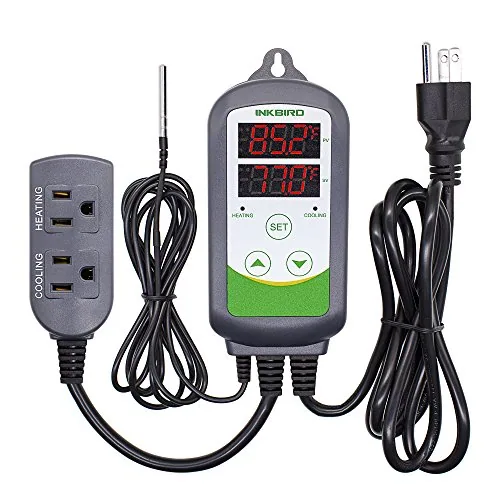
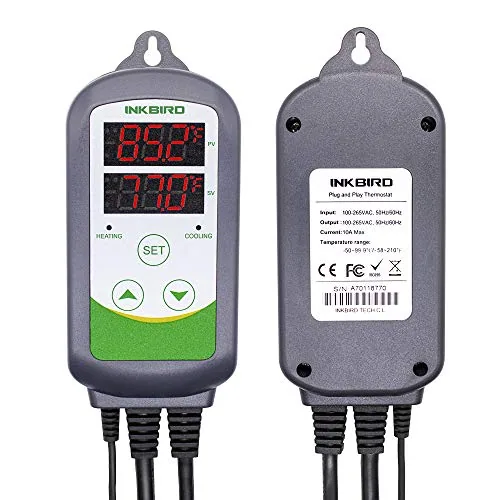
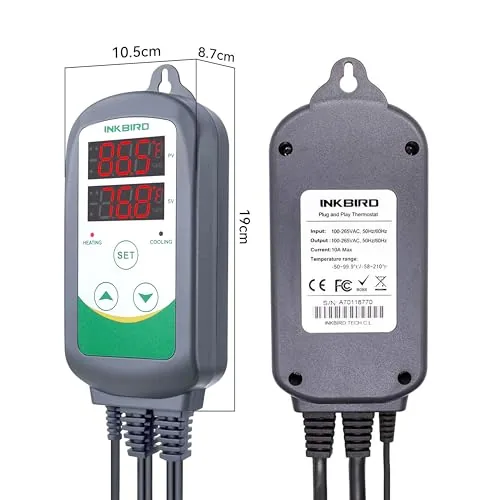
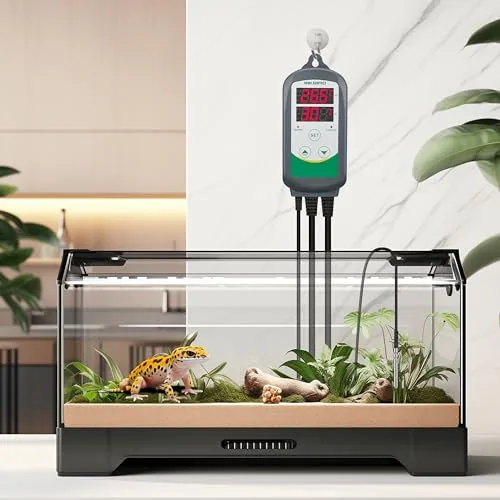
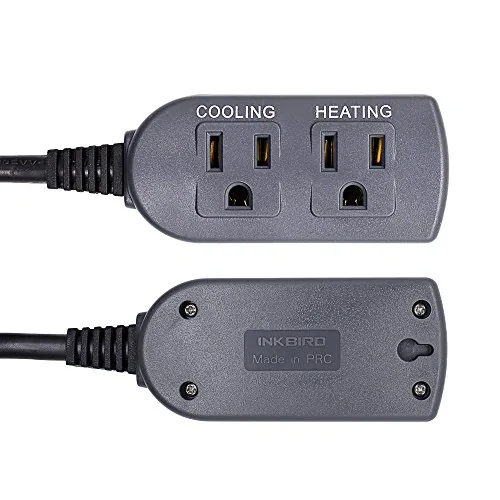
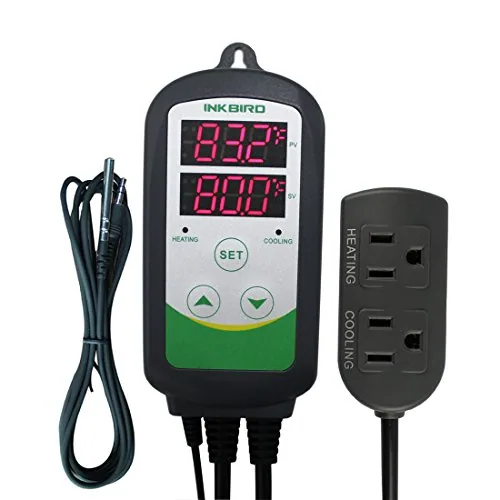
- Two outlets: one for cooling (fridge or freezer), one for heating (wrap, belt or pad). It switches between them automatically.
- Load rating: 1200 W at 110V and 10 A max per Inkbird's manual; 1100 W per this listing. Stay well under the lower figure.
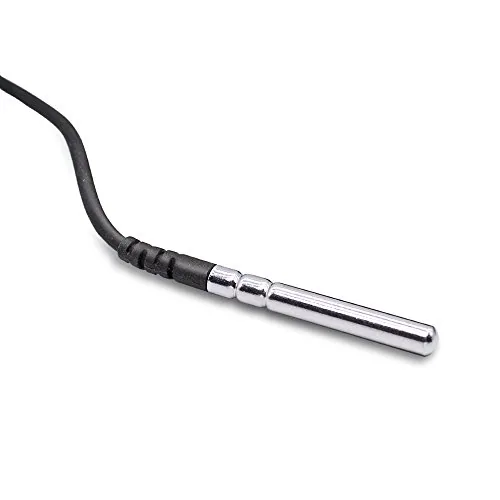
- Control range −58 to 210°F (−50 to 99°C), accuracy ±1°F, 6.56 ft (2 m) NTC probe, per the manual.
- Set the compressor delay (default 3 minutes, 0–10) to protect a fridge's compressor.
- Changing °C/°F resets every setting to factory defaults, per the manual. Set units first.
This Inkbird ITC-308 review covers the standard 110V dual-stage controller. Fermentation temperature affects flavor more than almost anything else on brew day: ale yeast that runs too warm makes fruity, solvent-like flavors, and lager yeast needs cool, steady temperatures. A controller like the ITC-308 holds a chosen temperature in a chest freezer, a mini fridge or a heated box.
We read Inkbird's ITC-308 user manual (version 2.2), the listing and published brewing sources. We did not wire or run one. For more controllers and chambers, see the fermenters and temperature control hub and the temperature control and summer page.
Who it’s for, and who should skip it
- Want to turn a spare fridge or chest freezer into a fermentation chamber
- Brew in a garage that swings hot in summer and cold in winter
- Need both heating and cooling from one controller
- Want a plug-in unit with no wiring
- Want app control and alerts on your phone (look at the ITC-308 Wi-Fi)
- Need precise PID control for a kettle or a heating element
- Plan to run heaters that together approach 1100 W
- Want a probe rated for submersion in liquid (look at the ITC-308S with an IP68 stainless probe)
Pros and cons
- Separate heating and cooling outlets, switched automatically
- Separate heating and cooling differentials (1–30°F)
- Adjustable compressor delay protects fridge compressors
- High and low temperature alarms plus a sensor fault alarm
- Temperature calibration offset of ±15 degrees
- Dual display shows measured and set temperature together
- Plug-and-play: no wiring needed
- Load rating differs between the manual (1200 W) and this listing (1100 W)
- On/off control only; no PID
- No app or logging on the standard version
- Switching °C/°F resets all settings
- Standard NTC probe isn't sold as a waterproof submersible probe
Specs
| Outputs | 2 outlets: heating and cooling |
|---|---|
| Range | °C/°F display, high/low alarms |
| Power | 110V, 10A, 1100 W max (listing) |
As stated by the maker or seller; confirm on the listing before you buy.
ITC-308 load rating: 1100 W or 1200 W?
This listing says the maximum output load is 1100 W at 110V and 10 A. Inkbird's ITC-308 manual (v2.2) lists 1200 W at 110V and 2200 W at 220V, with outputs of 10 A maximum and relay contacts rated 10 A for cooling and heating. A newer ITC-308S listing also says 1200 W. The likely explanation is different production runs or listings, but we can't confirm which one your unit carries.
The manual is the reference: 1200 W at 110V. In practice, for fermentation it doesn't matter much. A chest freezer or mini fridge on the cooling outlet and a 35–40 W heat wrap on the heating outlet are a small fraction of either figure. Don't plug space heaters, power strips or kettle elements into it, and don't run it on an extension cord in a damp garage.
Inkbird ITC-308 specs from the manual
| Item | Figure |
|---|---|
| Control range | −58 to 210°F (−50 to 99°C) |
| Resolution | 0.1°F / 0.1°C |
| Accuracy | ±1°F (−58 to 160°F) / ±1°C (−50 to 70°C) |
| Control mode | On/off, heating and cooling |
| Input power | 100–240 VAC, 50/60 Hz |
| Max output load | 1200 W (110V) / 2200 W (220V); 10 A max |
| Probe | NTC, 2 m (6.56 ft) |
| Cables | Input 1.5 m (5 ft); output 30 cm (1 ft) |
| Operating ambient | −22 to 167°F (−30 to 75°C) |
| Warranty | 1 year |
Source: Inkbird ITC-308 user manual v2.2
Settings to change on day one
The ITC-308 ships with defaults meant for general use, including a Celsius display and a 77°F set point. Set the units first, because changing CF resets every other value to factory settings.
ITC-308 menu, Fahrenheit mode
| Code | Function | Range | Default | Typical ale setting |
|---|---|---|---|---|
| CF | °C or °F | C / F | C | F (set this first) |
| TS | Set temperature | −50 to 210°F | 77°F | Yeast's range, e.g. 64–68°F |
| CD | Cooling differential | 1–30°F | 3°F | 1–2°F |
| HD | Heating differential | 1–30°F | 3°F | 1–2°F |
| PT | Compressor delay | 0–10 min | 3 min | 3–5 min for a fridge |
| AH / AL | High / low alarm | −50 to 210°F | 200 / −40°F | A few degrees outside your range |
| CA | Calibration offset | ±15° | 0 | Check against a reference thermometer |
Source: Inkbird ITC-308 user manual v2.2
Per the manual, cooling starts when the reading reaches TS + CD and stops at TS; heating starts at TS − HD and stops at TS. A flashing cooling light means the compressor delay is holding the fridge off. The typical settings above are our suggestions, not Inkbird's; follow your yeast maker's temperature range.
Dry yeast by the maker’s numbers
| Yeast | Use | Fermentation temp | Dose | Attenuation / tolerance | Rehydration |
|---|---|---|---|---|---|
| SafAle US-05 Fermentis | Ale (American) | 18–26°C (64.4–78.8°F) | 50–80 g/hL | 78–82%; not listed on the product page | Optional: ≥10× its weight of sterile water or boiled, hopped wort at 25–29°C (77–84°F), 15–30 min; or direct pitch at or above fermentation temperature |
| SafAle S-04 Fermentis | Ale (English) | 18–26°C (64.4–78.8°F) | 50–80 g/hL | 74–82%; 9–11% ABV | Optional: ≥10× its weight of sterile water or boiled, hopped wort at 25–29°C (77–84°F), 15–30 min; or direct pitch at or above fermentation temperature |
| SafLager W-34/70 Fermentis | Lager | 12–18°C (53.6–64.4°F) | 80–120 g/hL | 80–84%; 9–11% ABV | Optional: ≥10× its weight of sterile water or boiled, hopped wort at 15–25°C (59–77°F), 15–30 min; or direct pitch at or above fermentation temperature |
| LalBrew Nottingham Lallemand | Ale (English) | 10–25°C (50–77°F) | 50–100 g/hL | 78–84%; 14% ABV | Dry pitching is the maker's preferred method (no significant difference vs rehydration, per Lallemand) |
| LalBrew Voss (kveik) Lallemand | Ale (kveik) | 25–40°C (77–104°F) Optimum 35–40°C (95–104°F) per Lallemand | 50–100 g/hL | 76–82%; 12% ABV | Per the sachet |
| Lalvin EC-1118 Lallemand | Wine, cider, mead | 10–30°C (50–86°F) | 25 g/hL | Ferments dry; 18% v/v (subject to conditions) | 35–40°C (95–104°F) water for 20 min with Go-Ferm Protect Evolution (30 g/hL), then temper to within 5–10°C of the must |
Sources: Fermentis: SafAle US-05 product page; Fermentis: SafAle S-04 product page; Fermentis: SafLager W-34/70 product page; Lallemand: LalBrew Nottingham technical data sheet; Lallemand Brewing: LalBrew Voss Kveik Ale Yeast product page; Lallemand: Lalvin EC-1118 technical data sheet. 1 hL = 26.4 US gal, so 50 g/hL ≈ 1.9 g per gallon. Follow the sachet you buy; makers update their sheets.
Where should the probe go?
Measure the beer, not the air. Tape the probe flat against the side of the fermenter at the level of the beer and cover it with a piece of foam or folded towel so the fridge air doesn't fool it. A thermowell, a stainless tube that reaches into the beer, is even better. If you use a floating hydrometer such as the Tilt, compare its temperature with the controller's reading; our Tilt review covers it.
Active fermentation makes heat, so the beer can run several degrees above the air for the first few days. That is why air-only readings often lead to warm ferments. Record set points and readings for each batch in the brew-day log, and pitch enough yeast with the help of the yeast pitch rate calculator.
Printable brew-day log and recipe sheetNote your controller set point, differential and the beer's temperature each day.Building a fermentation chamber around it
- Pick the box
A chest freezer, a mini fridge that fits your fermenter, or a homebrew kegerator that can double as a chamber.
- Add heat
A heat wrap or belt on the fermenter, plugged into the heating outlet, for cold garages and lagers.
- Place the probe
Taped and insulated against the fermenter, or in a thermowell.
- Set units, then values
CF first, then TS, differentials, compressor delay and alarms.
- Check it empty
Run it a day with a jug of water inside before you trust it with beer.
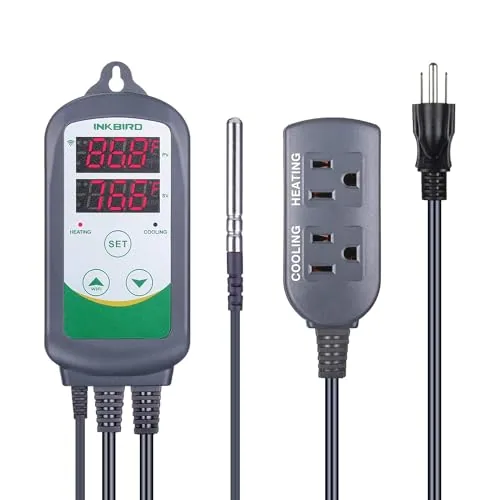
Inkbird ITC-308 Wi-Fi Dual-Stage Temperature Controller, 110V
- Outputs
- 2 outlets: heating and cooling
- Range
- °C/°F, calibration, high/low alarms
- Power
- 110V, 1100 W max (listing)
Best for Remote fermentation monitoring
Inkbird ITC-308S Dual-Stage Controller with Stainless Probe
- Material
- 100–240V; IP68 stainless probe
- Outputs
- Dual relay: heating and cooling
- Range
- °C/°F, alarms
Best for Thermowell temperature control
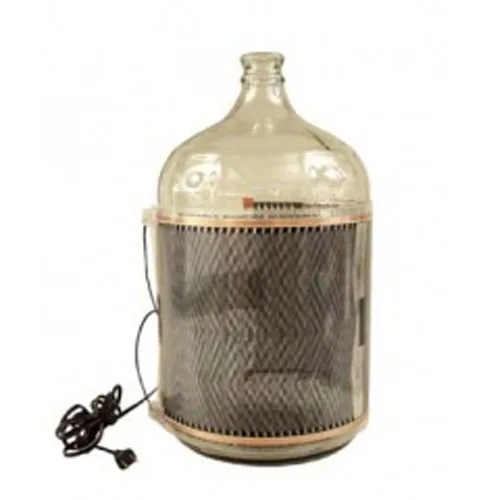
Eagle Brewing FE650 FermWrap Heater, 40W
- Material
- Flexible wrap, tape-on
- Outputs
- Flexible heating wrap, 40 W
- Type
- Fermentation heater
Best for Warming ales in a cold garage
Our best fermentation temperature controllers list compares the ITC-308 with other controllers and heaters. Most plug-in dual-stage controllers sold for homebrewing in our catalog are Inkbird models, so the alternatives below are other ways to control temperature.
Alternatives worth a look
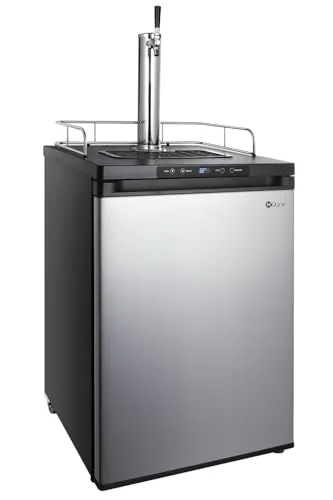
Kegco HBK309S-1 Homebrew Kegerator, 1 Tap, Stainless
- Taps
- 1
- Kegs
- Homebrew (ball lock) kegs
- Temp range
- Digital, 1° steps; Deep Chill; dispense or ferment
Best for One beer on tap
Built-in control: Kegco's single-tap homebrew kegerator has its own digital thermostat and a range wide enough to double as a fermentation chamber, per Kegco.
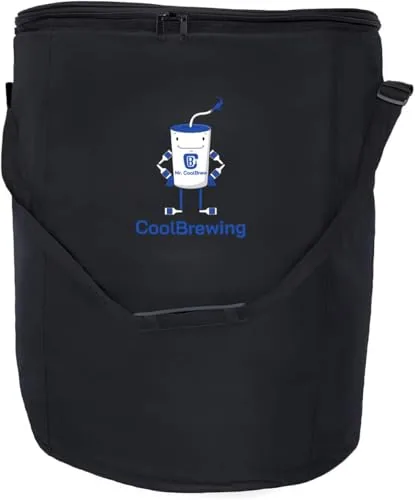
Cool Brewing Fermentation Cooler Bag
- Volume
- Fits a 5 gal fermenter
- Outputs
- Insulated bag for ice bottles or packs
- Type
- Insulated fermentation bag
Best for Summer ales without a fridge
No power needed: An insulated bag cooled with frozen bottles; the maker says two frozen 2-liter bottles drop it about 10°F below room temperature.
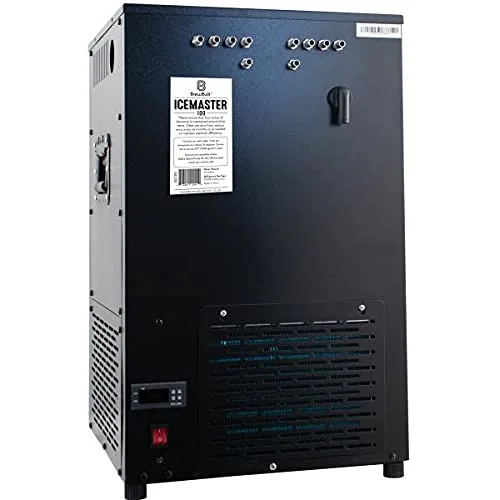
BrewBuilt IceMaster 100 Glycol Chiller
- Volume
- 30 L (8 gal) water tank
- Outputs
- 10 stainless bulkheads, 3/8 in. barbs
- Range
- 950 W / 3200 BTU cooling, 110V 3.6 A
Best for Cooling stainless conicals
For several fermenters: A 110V glycol chiller with a 30 L tank, 950 W (3200 BTU) of cooling and ten bulkheads for jacketed or coiled fermenters.
We read the maker’s specs, the manual and the current listing, and checked them against published brewing sources (Palmer, BJCP, AHA, BYO) and safety guidance where it applies. We did not brew with, install or lab-test this product. We never show scores, star ratings or prices.